Article



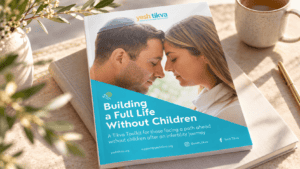
When their journey doesn't end with a baby...what do you do?
For many, the hope for a child is not casual. It is woven into dreams, plans, identity, prayer, and community and social narrative. When someone chooses or comes to accept a life without children after infertility, it is not a small pivot. It is often the result of years of courage, heartbreak, decision-making, and reckoning. It likely requires revisiting and reshaping one’s plans and identity for the future.
That can feel like a tall order. Thankfully, Jewish tradition reminds us that a life is never measured by one role alone.
Our tradition offers countless pathways to meaning, connection, impact, and sacred contribution, whether or not someone becomes a parent. A person’s worth, legacy, and holiness are not contingent on raising children. Every mitzvah, every act of kindness, every relationship nurtured, every contribution to community are threads that hold the future together.
Those moving forward without children still help shape the generations to come.
They still build.
They still teach.
They still give.
They still matter.
Infertility and the decision to remain childfree (or end a journey after secondary infertility) are deeply personal journeys. This is not a problem to solve. It is not your role to brainstorm alternatives, suggest “next steps,” or offer spiritual explanations.
The most supportive thing you can do is listen without judgment, respect their autonomy, and stand beside them without trying to repair what cannot be repaired.
Words matter deeply here. Avoid framing their path as:
Instead, choose language that reinforces dignity and agency:
This path is rarely tidy. They may feel grief and relief in the same week. Acceptance and anger in the same day. Peace and hope and then sudden waves of sadness and loss.
Allow complexity. Don’t rush them toward gratitude or “closure.” Closure is not always linear. Healing is almost never linear. The “untidiness” of emotions can feel uncomfortable, even as a witness. Sitting in the pain, joy, and everything in between is part of being truly supportive.
You can gently ask:
Unless they’ve asked you to, your role is not to cheer them up or push them toward a different emotion (or decision). Holding space without correcting their feelings is an invaluable gift.
One of the deepest wounds can be quiet social exile. Even those with a beautiful community around them can find themselves being subtly categorized as “other” after their journey ends.
Please:
Invite them to life cycle events while giving them space to attend or not without consequence or assumption.
Avoid making parenting the center of every conversation you have with them.
Recognize their contributions publicly.
See them as whole.
Community belonging should not hinge on parental status.
Remaining childfree after infertility is not a “second-best” existence. It is a real life. A full life. A sacred life.
Judaism teaches that every soul has purpose. That purpose is not singular. It is not narrow. It is not limited to one expression.
There are many ways to build the world.
If someone you love is moving forward without children after infertility, the greatest gift you can offer is steady presence.
Not correction.
Not solutions.
Not silver linings.
Just this:
“I see you. I respect you. I am staying.”
Because a life of meaning is not defined by one path. Walking beside someone as they forge a new one is itself a holy act.

The Support Line offers a confidential space for emotional support, information, and referrals related to infertility and family-building challenges. A trained professional will meet with you for short-term support and help connect you to Yesh Tikva programs and trusted external resources.
We look forward to connecting with you.
Please note: This is not a crisis line. If you need immediate help, call 911 or your local emergency number. If you’re experiencing a mental health crisis or need immediate support, call or text 988 (U.S. & Canada) or use their online chat.