Article

One Educator’s Journey
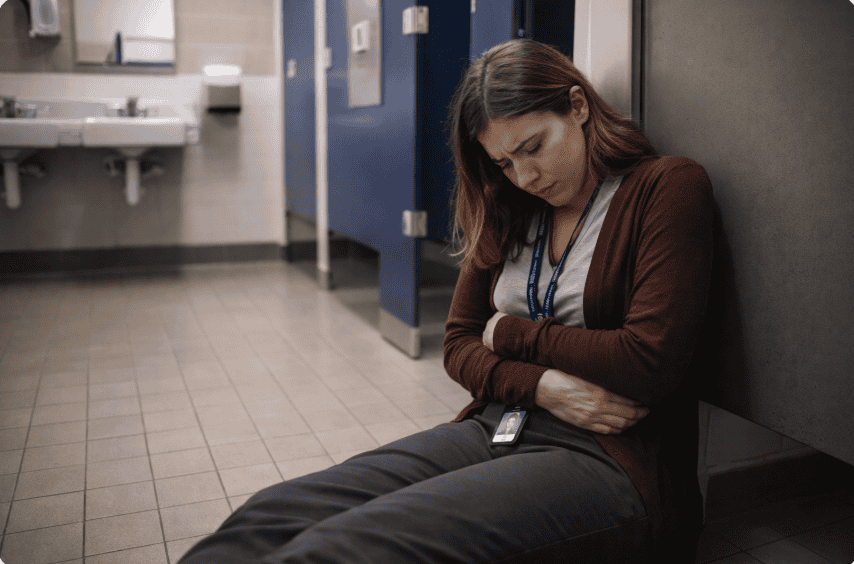
Nausea. Vomiting. Extreme pain. I sat in my college dorm hallway, staring at the doorway to the communal bathroom, hoping I wasn’t going to throw up again, too weak to get through the door to the privacy of my room. I was alone and uncomfortable. My community failed me. My education failed me. Nowhere did I hear that what I was experiencing wasn’t normal and that I should do additional testing to see what might be causing me to experience these symptoms for the first time.
The first time I heard the word endometriosis was when I received my diagnosis, over 15 years after showing my first symptoms. Endometriosis is a very common cause for infertility where the cells that should be lining your uterus grow outside the uterus.
You would think that this diagnosis is where my story begins, but the isolation of my experiences with women’s health actually began when I was 12. My first period happened at shul during the bat mitzvah of one of my classmates. Embarrassed and uncomfortable, I remember stuffing toilet paper into my underwear and praying that there were no wardrobe malfunctions, then returned to the social hall for brunch.
I was alone at 12. I was confused at 19. At 31, the explanations were not enough.
It took several years in my journey with infertility before I was ready to seek help beyond my husband, our therapist, and the medical professionals who were helping us. I stumbled on Yesh Tikva by accident as I was looking for resources. By this point, I had multiple diagnoses, I could barely talk about my experiences without crying, and I was furious that the lack of support earlier in life resulted in an inability to make certain choices about my future. I found myself deeply envious of friends who had no trouble conceiving and I started questioning my own identity and reconsidering how my life might look in a future without children.
I am an educator. When I reflected on the sex education provided in schools, the content I shared with my own students, I realized I was perpetuating the problem. The lessons we teach make it seem like a person is guaranteed to successfully conceive and carry a child to term if they were not on birth control and said the magic words “I’m trying to have children.” So I shifted my approach and changed how I taught my lessons. It was no longer a lesson about how we expect the human body to work, but instead about how the human body might work differently. The lesson became if something doesn’t feel right, find someone with whom you feel comfortable and ask them about it. If I had had a conversation like that as an adolescent, I might have done egg retrievals at 19 when I first experienced endometriosis symptoms, instead of being faced with the choice of using an egg donor, another non-traditional path, or not having children. At the very least, I would have had someone to hold my hand and encourage me to get a better understanding of what was happening.
I have discovered that any time I was brave enough to share my story, or dropped enough hints, there is always someone in the room with a story of their own to share, who doesn’t want to feel alone in the trauma they experienced. Someone needs to be the person to speak up first. As an educator, I cannot be silent.
This brings me back to Yesh Tikva. In 2023, I discovered their Infertility Awareness Shabbat (IAS), which their website describes as “a global initiative inviting synagogues, schools, and Jewish communities to deepen compassion for those navigating infertility and complex family building.” I reached out to my clergy, with whom I am fortunate to have a relationship that spans several decades, and we put together programming in which I shared my journey with the community. After services, several congregants came to me to share their own connections, including one who realized that her granddaughter (a former classmate of mine) had actually been on a fertility journey that had recently culminated with the birth of twins. In the time since then, several congregants have remembered my drash and mentioned how valuable it was, and that the conversation should be ongoing. My willingness to talk about my own experiences and to share resources has led people to seek out my advice.
This journey doesn’t have to happen alone. We can make sure of that. It’s about small, repeatable choices that as a community say, again and again: You belong here. Exactly as you are.

The Support Line offers a confidential space for emotional support, information, and referrals related to infertility and family-building challenges. A trained professional will meet with you for short-term support and help connect you to Yesh Tikva programs and trusted external resources.
We look forward to connecting with you.
Please note: This is not a crisis line. If you need immediate help, call 911 or your local emergency number. If you’re experiencing a mental health crisis or need immediate support, call or text 988 (U.S. & Canada) or use their online chat.